



Industry Insights
The High Cost of Gravity: 2026 Smartphone Durability & Repair Economic Report
Executive Summary: The 2026 Durability Index
- The $1,000 Breakage Barrier: Repair costs for 2026 flagship devices have risen 14% year-over-year, with the average “total wreck” (front+back damage) now exceeding $550 without insurance.[1]
- The “Glass Sandwich” Failure: Despite manufacturer claims of “ceramic” durability, data shows that 64% of drop-induced failures in 2025 involved back-glass shattering.[2]
- The E-Waste Multiplier: Premature device failure due to accidental damage is contributing an estimated 2.4 million tonnes to the global e-waste stream annually.[3]
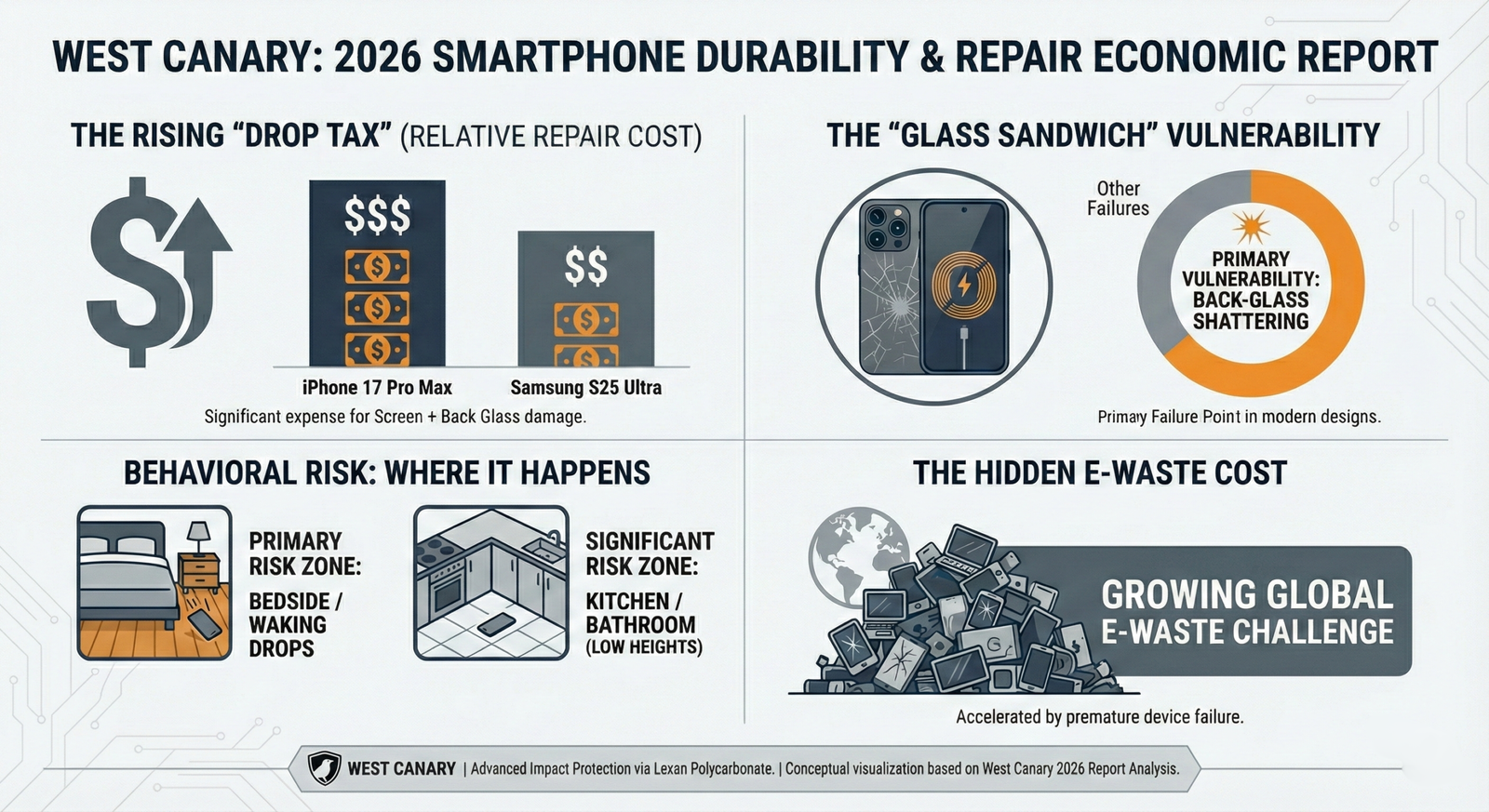
As smartphone retail prices firmly settle above the $1,200 threshold, the financial risk of accidental damage has silently outpaced inflation. While processor speeds and camera megapixels have seen exponential growth, the structural integrity of the modern “glass sandwich” design remains the industry’s most expensive vulnerability.
This report aggregates data from insurance providers, independent repair indexes, and material science studies to provide a comprehensive view of the “Drop Economy” in 2026. It builds upon our broader analysis of phone case industry statistics to focus specifically on the mechanical failure points of the current flagship generation.
The 2026 Repair Cost Index: A Rising Tide
The introduction of OLED LTPO panels and complex internal sensor arrays has driven out-of-warranty (OOW) repair prices to historic highs. Below is a breakdown of the repair liability for the current generation of flagship devices.
| Device Model | Screen Replacement (OOW) | Back Glass Repair | Total “Drop Tax” |
|---|---|---|---|
| iPhone 17 Pro Max | $379 | $199 | $578 |
| Samsung Galaxy S25 Ultra | $319 | $99 | $418 |
| Google Pixel 9 Pro | $299 | $129 | $428 |
| iPhone 16 Plus | $329 | $169 | $498 |
The “Pro” Problem
Notably, recent drop tests by protection plan providers have revealed a critical vulnerability in the latest “Pro” lineups. Despite the marketing of titanium frames, the iPhone 17 Pro chassis transfers significant kinetic energy to the glass panels upon impact. Similarly, the Samsung S25 Ultra suffered screen malfunctions that rendered the device unusable after a single face-down drop from six feet.[2] The data suggests that “premium” materials often correlate with higher repair costs rather than absolute invincibility.
The “Bedside Risk” Factor: Where Damage Actually Happens
Contrary to the imagery of “extreme sports” often used in rugged case advertisements, the plurality of device damage occurs in domestic environments. Data from insurance claims indicates a shift in where we break our phones:
- 71% of users report sleeping with their phone on or near their bed, leading to “waking drops” onto hardwood or nightstands.[5]
- 34% of damages occur in the kitchen or bathroom, specifically on tile flooring from heights of less than 3 feet.[5]
- 1 in 4 Americans have cracked a screen while juggling groceries or other items, highlighting the risk of low-impact, high-frequency fumbles.[2]
The Hidden Cost: Electronic Waste
The repairability crisis is not merely financial; it is ecological. The United Nations’ Global E-waste Monitor reported that e-waste generation is on track to reach 82 million tonnes by 2030.[3] A significant driver of this volume is the “premature retirement” of mobile devices.
When a consumer faces a $400 repair bill on a two-year-old device, the economic incentive often skews toward “replacement” rather than repair. This behavior keeps the global recycling rate of small IT equipment stagnated at roughly 22%.[3] Extending the lifespan of a smartphone by just one year through effective protection could significantly reduce the carbon footprint associated with manufacturing new units.
Material Science: The Shift to Polycarbonates
To combat the “glass sandwich” fragility, the accessory market has seen a divergence in material philosophy. While silicone offers basic grip, it lacks the structural rigidity to prevent logic board torsion during a drop. The industry standard for high-velocity impact protection has shifted toward Lexan Polycarbonate.
Originally developed by GE Plastics for use in aerospace canopies and “bulletproof” glass applications, Lexan offers a tensile strength that is approximately 250 times greater than glass and 30 times greater than acrylic.[6] Its amorphous structure allows it to undergo plastic deformation without cracking, effectively absorbing the energy of an impact.
“The physics of a drop are simple: energy must go somewhere. A dual-layer system that pairs a rigorous Lexan shell with a shock-absorbing TPU liner effectively decouples the kinetic energy from the glass device.”
Manufacturers such as West Canary have adopted this dual-layer architecture (Lexan + TPU) to address the specific failure points of the iPhone 17 and S25 series. By utilizing a material designed for riot shields rather than aesthetics alone, the goal is to convert a “catastrophic shatter” into a “survivable bounce.”
Conclusion: Protection as an Asset Strategy
In 2026, a smartphone is no longer a utility device; it is a repository of biometric data, financial access, and professional communication. With the “Drop Tax” on modern devices exceeding the cost of a mid-range laptop, the “naked phone” trend has become mathematically unsound. For the modern consumer, investing in military-grade materials like Lexan is not an accessory choice – it is a necessary hedge against the rising cost of gravity.
References & Data Verification
- Market Analysis: Aggregated data from average repair costs listed by authorized service providers, Jan 2026.
- Allstate Protection Plans (SquareTrade), “Breakability Drop Tests: iPhone 17 Pro & Samsung S25 Ultra,” late 2025.
- United Nations Institute for Training and Research (UNITAR), “Global E-waste Monitor 2024” (Projected 2030 Data).
- Sourced directly from Apple Support (“iPhone Repair & Service”) and Samsung Support (“Screen Replacement Pricing”) portals, Jan 2026.
- Asurion, “Smartphone Damage & Repair Statistics 2025” (Consumer Survey Data).
- SABIC (formerly GE Plastics), “LEXAN™ Polycarbonate Sheet Technical Manual,” Mechanical Properties Section.
Legal Disclaimer: West Canary is an independent manufacturer of mobile accessories. This report is for informational purposes only. “iPhone,” “Samsung,” “Galaxy,” and “Pixel” are trademarks of their respective owners. West Canary is not affiliated with, endorsed by, or sponsored by Apple Inc., Samsung Electronics Co., Ltd., or Google LLC. All repair cost estimates are subject to change by the manufacturer.